Why You Need a Cloud Kitchen Business Plan
The cloud kitchen industry in India is expanding rapidly as customers increasingly prefer online food delivery. This shift has led many entrepreneurs to explore delivery-focused food brands. However, launching a successful operation requires a structured cloud kitchen business plan that outlines your vision, budget, menu strategy, operational setup, and marketing roadmap.
A professional business plan helps you:
- Estimate startup and operational costs
- Understand customer demand and competition
- Define menu and brand identity
- Plan staff, equipment, and workflow
- Build a stable, profitable model
- Pitch your idea to investors or partners
A well-defined business plan is the foundation of a long-lasting, scalable cloud kitchen.
Key Components of a Cloud Kitchen Business Plan
Creating a structured business plan involves understanding both financial and operational aspects. Below are the essential elements every owner must include.
1. Market Research and Feasibility Analysis
Begin with an analysis of the target customer base, cuisine popularity, and competitor presence. Understanding your local market ensures your idea remains relevant and profitable.
Your feasibility study should cover:
- Target demographics
- Delivery demand within a radius
- Cuisine gaps and customer preferences
- Competition analysis on platforms like Swiggy and Zomato
- Average selling price of popular dishes
Roots Restaurant Consultancy provides feasibility studies to validate business ideas and estimate potential ROI.
Explore services: https://rootsrestaurantconsultancy.com/services/
2. Defining the Business Model
A critical section of the cloud kitchen business plan is selecting the right operational model. Each format comes with different cost structures and scalability potential.
Common business models include:
- Single-brand kitchen
- Multi-brand kitchen from a shared facility
- Co-working or rented kitchen space
- Franchise cloud kitchen
- Hybrid delivery model with takeaway
Identify which structure aligns with your investment capacity and long-term goals.
3. Menu Planning and Recipe Standardization
Your menu is the core driver of your kitchen operations. A focused, well-engineered menu keeps equipment costs low, improves efficiency, and increases profitability.
Elements of a strong menu plan:
- Compact menu with high-demand dishes
- Ingredient overlap to reduce inventory cost
- Food costing and pricing strategy
- Recipes designed for delivery stability
- Standardized SOPs for consistent quality
Roots supports menu engineering to improve food cost margins and ensure operational consistency.
4. Location and Kitchen Layout Planning
While cloud kitchens do not require high-footfall spaces, location still impacts delivery times and rental expenses.
Ideal location requirements:
- High-density residential or corporate zones
- Quick access for delivery partners
- Sufficient ventilation and water connectivity
- Affordable rent and manageable deposit
Kitchen layout planning includes:
- Equipment placement
- Prep, cook, and pack zones
- Exhaust and ventilation system
- Storage design
- Dispatch counter setup
Roots provides complete kitchen layout and workflow planning for efficient operations.
5. Budgeting and Cost Structure
One of the most important parts of a cloud kitchen business plan is calculating your investment. Planning your budget prevents overspending and ensures a better return on investment.
Typical startup cost components:
- Equipment: ₹1.5–₹6 lakh
- Licensing: ₹15,000–₹40,000
- Infrastructure: ₹40,000–₹1.5 lakh
- Branding: ₹30,000–₹1 lakh
- Staff salaries: ₹60,000–₹1 lakh per month
- Inventory: ₹20,000–₹50,000
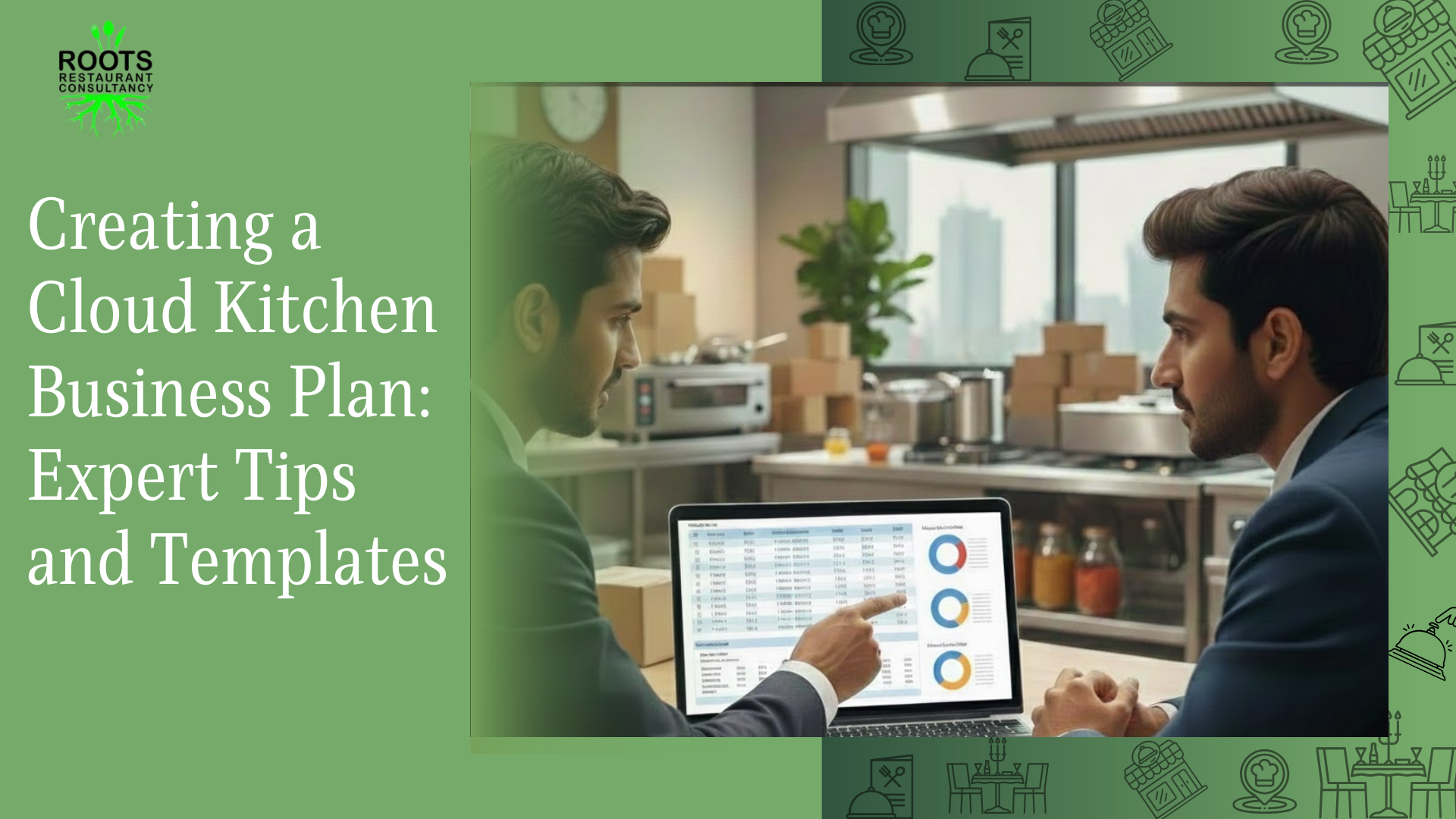
Create a cost table to estimate initial and monthly operational expenses clearly.
6. Licensing and Compliance Planning
Your business plan must outline mandatory licenses and expected timelines. This avoids last-minute delays during launch.
Required licenses include:
- FSSAI License
- Shop & Establishment Certificate
- Trade License
- Fire NOC (if needed)
- GST registration
Roots handles the entire licensing process to ensure full compliance.
7. Staffing Structure and Training
Cloud kitchens require fewer staff members than dine-in restaurants, but proper training is essential for maintaining speed, hygiene, and quality.
Staffing plan includes:
- Number of cooks and helpers
- Desired skill levels
- Training modules
- Shift management
- Performance KPIs
Roots provides ongoing training support for kitchen teams.
8. Technology and POS Integration
Technology is the backbone of a digital-first food business. Your business plan should outline the systems you’ll use for:
- POS and billing
- Inventory management
- Order integration with aggregators
- KDS (Kitchen Display System)
- Your own website or ordering app (optional)
9. Branding and Marketing Strategy
Branding plays a significant role in visibility on food delivery apps. A strong digital presence helps attract customers quickly.
Your branding strategy should outline:
- Brand name and story
- Logo and packaging design
- Food photography
- Social media plan
- SEO and digital campaigns
- Influencer collaborations
Roots offers complete branding solutions to strengthen your market presence.
Templates to Include in Your Cloud Kitchen Business Plan
To make planning easier, add these practical templates to your document:
1. Business Model Canvas Template
Includes:
- Value proposition
- Customer segments
- Revenue streams
- Key activities and partners
- Cost structure
2. Menu Engineering Template
Tracks dish cost, selling price, and contribution margin.
3. Startup Budget Template
Lists equipment, licensing, branding, and setup costs.
4. Monthly Profit & Loss Template
Includes fixed and variable expenses to monitor profitability.
5. Operational SOP Template
Outlines recipe instructions, hygiene standards, and dispatch protocols.
Conclusion: Building a Strong Cloud Kitchen Business Plan
A well-structured cloud kitchen business plan is essential for launching a successful delivery-focused food business in India. With clear market analysis, menu engineering, budgeting, staffing strategies, and operational planning, entrepreneurs can reduce risk and scale efficiently.
Professional consulting ensures your plan is accurate, realistic, and aligned with industry standards. With expert guidance and efficient systems, your cloud kitchen can grow quickly and operate profitably in today’s expanding food delivery market.