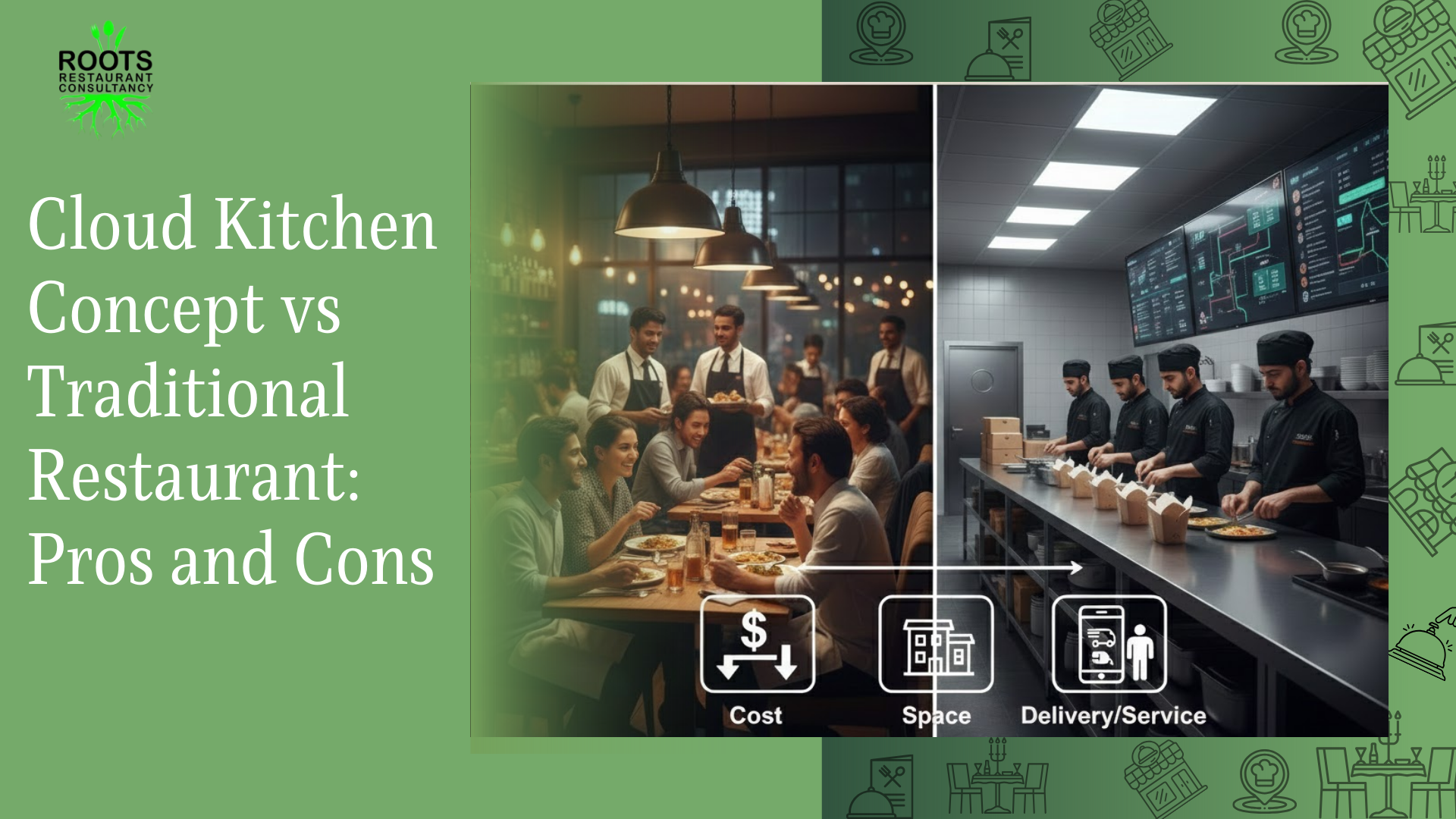
Understanding the Cloud Kitchen Concept in Today’s Food Industry
The rise of online delivery platforms has reshaped the way customers experience food. This shift has increased interest in the cloud kitchen concept, a model that focuses solely on delivery without dine-in facilities. Meanwhile, traditional restaurants continue to rely on in-person dining, ambience, and service.
Both models offer unique advantages, and choosing the right one depends on your goals, budget, and business strategy. This comparison breaks down how each format works, their strengths, limitations, and how expert guidance can help you build a sustainable food business.
What Defines a Cloud Kitchen Concept?
The cloud kitchen concept is a delivery-based food production model that operates without a dining area. Orders come exclusively through online platforms such as Swiggy and Zomato, while the kitchen focuses on quick preparation, packaging, and dispatch.
This model uses minimal staff, smaller spaces, and streamlined digital operations, making it ideal for new entrepreneurs or established brands seeking expansion with lower investment.
Key features of a cloud kitchen model:
- No dine-in area or customer seating
- Orders accepted online only
- Compact kitchen infrastructure
- Lower staff requirement
- Ease of scaling multiple virtual brands
Roots Restaurant Consultancy helps entrepreneurs develop delivery-oriented brands through concept creation, layout planning, and menu engineering.
Explore services: https://rootsrestaurantconsultancy.com/services/
How a Traditional Restaurant Operates
A traditional restaurant is built around customer experience, offering dining space, ambience, table service, and in-person interaction. This model requires higher investment, more staff, and strategic location planning.
Core elements of a traditional restaurant:
- Dining area with seating
- Front-of-house staff
- Interior design and ambience planning
- Higher rental costs
- Strong emphasis on customer experience
Pros of the Cloud Kitchen Concept
1. Lower Startup and Operating Costs
Without the need for seating, décor, and service staff, the new-age kitchen model requires significantly lower investment. Rent, electricity, manpower, and interiors are all minimized.
2. Easy Scalability
Brands can operate multiple virtual restaurant models from the same kitchen. This allows rapid expansion without increasing physical space.
3. Data-Driven Decision Making
Delivery platforms provide customer insights, enabling owners to improve menu design, pricing, and marketing.
4. Flexible Locations
Cloud kitchens can operate from non-prime areas as long as delivery coverage is strong.
5. Faster Launch Timeline
A delivery-focused operation can be launched within weeks with the right consultants and operational planning.
Cons of the Cloud Kitchen Model
1. Heavy Reliance on Delivery Platforms
A major share of orders comes from aggregators, which charge commissions that may affect margins.
2. Limited Brand Visibility
Without physical presence, visibility must be built through digital marketing and packaging identity.
3. High Competition
Delivery apps often list many similar brands, increasing competition within cuisine categories.
4. Packaging and Logistics Challenges
Food must travel well, requiring proper material selection and quality-controlled dispatch systems.
Pros of a Traditional Restaurant
1. Strong Brand Experience
Ambience, music, service, and décor create memorable dining experiences that influence customer loyalty.
2. Multiple Revenue Channels
Traditional restaurants can earn through dine-in, takeaway, catering, and online delivery.
3. Higher Perceived Value
Customers are often willing to pay more due to the overall dining experience, helping improve average order value.
4. Better Community Presence
A strong neighbourhood store builds long-term relationships and word-of-mouth promotion.
Cons of a Traditional Restaurant
1. Higher Investment
Infrastructure, interiors, seating, and staff hiring significantly increase startup costs.
2. Longer Setup Time
Design, licensing, construction, and branding result in longer launch timelines.
3. Increased Operational Complexity
Managing kitchen, staff, service, inventory, and guest satisfaction requires robust systems.
4. Sensitivity to Footfall
Poor location or limited visibility can severely impact profitability.
Cloud Kitchen Concept vs Traditional Restaurant: Key Comparison
| Aspect | Cloud Kitchen Concept | Traditional Restaurant |
|---|---|---|
| Investment | Low | High |
| Location Requirement | Flexible | Prime area needed |
| Staff Requirement | Minimal | Large staff |
| Customer Interaction | None | High |
| Revenue Streams | Online delivery | Dine-in, delivery, takeaway |
| Scalability | Very high | Moderate |
| Branding Cost | High (digital only) | Moderate |
| Setup Timeline | Short | Long |
Which Model Should You Choose?
Choosing between the two depends on your goals:
Choose the cloud kitchen concept if you want:
- Low startup cost
- Quick launch
- Digital-first operations
- Option to run multiple brands
- Focus on delivery-only customers
Choose a traditional restaurant if you want:
- In-person customer experience
- A strong physical brand identity
- Higher average order value
- A premium dining ambience
Roots Restaurant Consultancy provides detailed feasibility studies, helping you identify which model fits your business goals and budget.
Explore services: https://rootsrestaurantconsultancy.com/services/
How Expert Consultation Helps
Professional consulting ensures that whether you choose a digital restaurant setup or a traditional format, you have:
- Cost-effective vendor sourcing
- Optimized kitchen layout
- Staff training and SOP creation
- Menu engineering for profitability
- Licensing and documentation support
- Branding and marketing strategy
Conclusion: Evaluating the Cloud Kitchen Concept vs Traditional Restaurant
Understanding the cloud kitchen concept helps aspiring owners evaluate a modern, scalable business model with lower investment and faster growth opportunities. Traditional restaurants, however, offer richer customer experience and premium branding potential.
Both formats can thrive when backed by strong concept planning, operational systems, and expert guidance. With the right consultancy support, you can confidently choose the format that aligns with your vision, budget, and long-term goals.